Eye Care > Diseases of the Eye > Cystoid Macular Oedema
What is Cystoid Macular Oedema?
Cystoid macular oedema (CME), or swelling of the macula, typically occurs as a result of disease, injury or more rarely, eye surgery. Fluid collects within the layers of the macula, causing blurred, distorted central vision. CME rarely causes a permanent loss of vision, but the recovery is often a slow, gradual process. The majority of patients recover in 2 to 15 months.
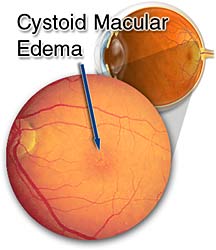
In this retinal photograph, the swelling is the yellowish spots (arrow) in the macula.
Signs and Symptoms
Blurred central vision
Distorted vision (straight lines may appear wavy)
Vision is tinted pink
Light sensitivity
Detection and Diagnosis
It is very difficult to detect CME during a routine examination. A diagnosis is often based on the patient’s symptoms and a special dye test called a fluorescein angiogram (FA).
Treatment
The first line of treatment for CME is usually anti-inflammatory drops. In certain cases, medication is injected near the back of the eye for a more concentrated effect. Oral medications are sometimes prescribed to reduce the swelling.
Illustrations by Mark Erickson With acknowledgement to St. Lukes Eye Hospital.